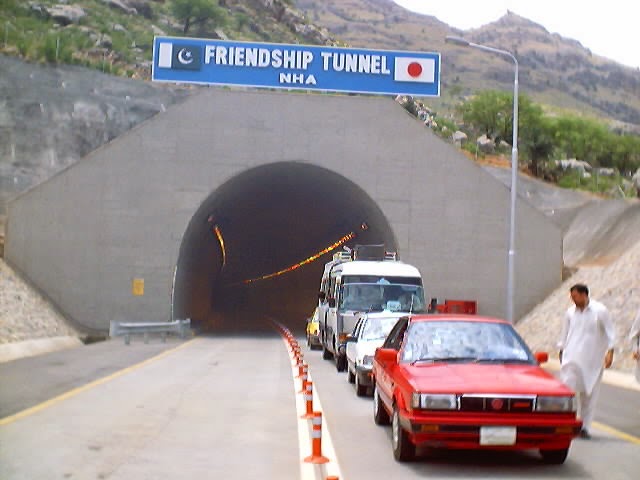
Kohat Tunnel

The Kohat Tunnel is a 1.9 kilometres (1.2 mi) was completed in 2004, and connects the southern districts, including Kohat City, to Peshawar. Constructed with Japanese assistance, it is also known as the Pak-Japan Friendship Tunnel.

Cadet College Kohat

Cadet College Kohat is a military high school for boys grades eight through twelve.The high school is located in the outskirts of Kohat, Pakistan.

Kohat University of Science and Technology

Kohat University of Science and Technology (KUST) is a public sector university established in 2001 at Kohat District, Khyber Pakhtunkhwa province of Pakistan by the governor, Lt. Gen. Syed Iftikhar Hussan Shah.

Kohat Cantonment

Kohat Cantonment is a cantonment adjacent to Kohat in Khyber Pakhtunkhwa, Pakistan.....

Kohat Railway Station

Construction of railway station and railway line was started in 1897, and was completed in 1902. Kohat is the terminus railway station of Kohat-Jand railway line and has daily train service to Rawalpindi. It was also the terminus station of a Narrow gauge (762 mm or 2 ft 6 in) railway line which connected it with Thall. This railway line was closed in 1991.

History of Kohat

Kohat is a city in the Khyber Pakhtunkhwa province of Pakistan. It is the capital of the Kohat Division. The town centers around a British-era fort, various bazaars and a military cantonment. A British-built narrow gauge railway line runs through the town.

Showing posts with label kohat. Show all posts

Friday, 5 December 2014

Kohat University of Science and Technology

Kohat University of Science and Technology (KUST) is a public sector university established in 2001 at Kohat District, Khyber Pakhtunkhwa province of Pakistan by the governor, Lt. Gen. Syed Iftikhar Hussan Shah.

History:

KUST attained the status of degree-awarding institution vide NWFP ordinance No. XXIII of 2001 and the subsequent notification No. Legis: 1 (12) 2001/4451-56, of August 30, 2001.
It had four institutes - Institute of Information Technology, Institute of Management Sciences, Institute of Education and Research and Department of Microbiology. These offered two-year and four-year Bachelor of Science (B.Sc) degrees and two-year Master degrees fields, in 2004. Later on the university was expanded by establishing departments in Physics, Chemistry, Botany, Zoology( Dr. Farzana Perveen has established department of Zoology KUST from the beginning and brings it up), and Microbiology. These departments offer BS (Hons.), M. Sc., M. Phil. and Ph.D. degree programmes.
The first Vice Chancellor of the university was Prof. Dr. Sher Ali Shah Shinwari (Late).
The university is ranked No. 22 in the General category of HEC rankings.

Faculties

Physical Sciences

  • Institute of Information Technology
  • Department of Mathematics
  • Department of Physics
  • Department of Chemistry

Social Sciences

  • Institute of Management Sciences
  • Institute of Education & Research
  • Department of English
  • Department of Economics
  • Department of Journalism & Mass Communication
  • Center of Religious Studies
  • Department of Social Work & Sociology

Biological Sciences

  • Department of Biotechnology & Genetics Engineering
  • Department of Microbiology
  • Department of Plant Sciences
  • Department of Zoology
  • Department of Pharmacy

Central Library

KUST library was established in early 2002. It begins its operation in September that year. The library established with a small collection of text and reference resources to fulfill need of the existing departments. In 2003 the library was consisted of only 2000 books. As the number of department increased, so does the collection at library increased. Presently KUST has 14 departments and 05 institutes. KUST Central Library Function as the Knowledge center for the university. It support directly & indirectly all the academic programmes of the university. Besides central library three branch libraries have also been established at KIMS, City Campus and at department of Chemistry. At the movement KUST library has a total collection of 25000 books.

Vice Chancellors

List of Vice Chancellors from the date of establishment:
  • Prof. Dr. Sher Ali Shah Shinwari (Late)(2001 - 2002)
  • Khalid Niazi (2003 - 2004)
  • Prof. Dr. Ihsan Illahi (2004)
  • Dr. Zabta Khan Shinwari (2004 - 2006)
  • Prof. Dr. Lutfullah Kakakheil (2007 - 2010.
  • Prof. Dr. Nasir Jamal Khattak(2011 - till now)


Photos

--------------------------------------------------------------

--------------------------------------------------------------
  ---------------------------------------------------------
---------------------------------------------------------

Saturday, 29 November 2014

Bina Ziarat Kohat

Bina Ziarat Kohat
Baina Ziarat Chashma Kohat KPK Pakistan is next to Ziarat Pir Zahoordin and is located in North-West Frontier Province, Pakistan. Its also an entertainment place like Jungle khel Chashma jaat in Kohat…


Watch What People of Kohat say about Bina Ziarat:


Kohat bina ziyarat video by LovelyKohat

Saturday, 11 October 2014

Cadet College Kohat (From Darkness unto Light)

Cadet College Kohat is a military high school for boys grades eight through twelve.The high school is located in the outskirts of Kohat, Pakistan.

History:

In Pakistan, Cadet Colleges were introduced by late Field Marshal, Muhammad Ayub Khan and these were established at Hasanabdal, Kohat and Petaro.

In pursuance of the recommendations of the Commission on National Education of the defunct Government of West Pakistan decided to establish another Cadet College to be the third in the province.

In recognition of the military services of the people of the area, Mr. Fateh Khan Bandial, the then Deputy Commissioner, Kohat, requested late Malik Amir Muhammad Khan, H.Pk, H.Q.A., the then Governor of West Pakistan that a Cadet College should be established at Kohat. Mr Fateh Khan acquired 144 acres (0.58 km2) of land for the college. The foundation-stone was laid by late Malik Amir M. Khan, on 19 April 1964.

The first entry of cadets was accepted in April 1965. Academic work started with 58 cadets and one boarding house called Jinnah House. Lt. Col. (Retd.) Faizullah Khattak (late) was its founding Principal.


Admin Block:

Cadet College Kohat has a large body of administration. This body of administration has its offices in Admin Block. Adjacent to admin block principal's office. Admin Block has following offices
  • Office of Vice Principal
  • Office of Director of Studies
  • Office of Controller of Exams
  • Office of Adjudant
  • Office of Director of Finance
Academic Block:

Cadet College Kohat has double story academic block. Academic Block consist of class rooms, assembly hall (Faizullah Khan Auditorium), Chemistry lab, Physics Lab (Dr. A. Q. Khan Labortary), Biology Lab and Computer Lab. It also consists of a staff room.

Houses (boarding houses):


The college is divided into six Boarding Houses spreading around the Academic Block in a semicircular shape. Houses are named after personalities of national and regional importance. Each House can accommodate up to 94 cadets and consists of ten small and two large dormitories. Apart from dormitories, there are six single rooms for the appointment holders and distinguished cadets who are selected from amongst the senior Cadets on the basis of their previous record and qualities of leadership. One of the members of faculty is appointed as an in charge of the House,known as House Master. A house tutor is available to all students during their prep and study times.
 Infrastructure:

The college is spread over an area of about 144 acres (0.58 km2). The buildings comprise an Academic Block, Admin Block, six boarding houses (spread around the Academic Block in a semicircular shape), three messes, a mosque, a gymnasium, a cafeteria, a swimming pool, a ten-bed hospital, several sports fields including six football grounds, six hockey fields, two cricket pitches, six basketball courts and two squash courts. The college has residential accommodation for the teaching and administrative staff.

Library:

Cadet College Kohat has rich collection of books in library named "KHURSHEED LIBRARY", (named after then Principal, Mirza Khurshid Anwar Beg) under the supervision of a qualified Librarian, the library is providing services to 542 Cadets and 230 College employees. Total Collection of the library is 30,000 books, including Islamic, Reference, Computer, History, Science and Arts Books. Similarly to provide latest information and to improve the English language of the Cadets, English & Urdu magazines, Journals, Digests, News papers etc., of National and International level have also been subscribed for library.

An audio-visual library has been set up with the latest equipment to acquaint the cadets with modern techniques of learning. The video projector, SANYO PLC-220P, LCD. Japan, the latest version, is also being utilized to screen the film, thereby replacing the old 35MM projector.

Mosque:

The college has a spacious and beautiful mosque. It has recently been renovated. More than 1000 people can pray/accommodate in Masjid Hall.

Hospital:

The college has a twenty-bed hospital along with two isolation rooms for special cases. A full-time medical officer assisted by two dispensers look after the health of cadets. The college hospital has its own ambulance. Cadets are referred to C.M.H. Kohat for medical treatment as well.

Messes / Dining Halls:

There are three messes catering for the needs of cadets. The Messing Officer supervise the working of the messes. The Caterer looks after the procurement and supply of dry and fresh provisions. Every effort is made to provide a balanced and nutritious diet with several fruits. Meals include breakfast, milk during breakfast, refreshment during break, lunch, evening tea and dinner. Recently Dining Hall is extended.

Notable alumni:

· Asif Sandila, Chief of Naval Staff

College Anthem:

Famous Poet Ahmad Faraz has written the College Anthem that is sung only in the Monday morning assembly.

Friday, 10 October 2014

Kohat Tunnel

The Kohat Tunnel is a 1.9 kilometres (1.2 mi) long road tunnel located in Khyber-Pakhtunkhwa province of Pakistan. Constructed with Japanese assistance, it is also known as the Pak-Japan Friendship Tunnel.

Construction on the tunnel began in 1999, and opened to traffic in June 2003. As part of the developing Indus Highway system, the tunnel serves as a shorter, alternate route to the Kohat Pass, situated between the cities of Peshawar and Kohat. The new route decreases the time required to travel through the Kotal Pass by about 20 minutes. The main advantage of the tunnel is that long bodied vehicles can now use the Indus Highway whereas previously the hairpin bends on the Kotal Pass made it impossible for such vehicles to travel. It also helps alleviate traffic congestion, improve traffic safety and promote economic development.

The tunnel was at the centre of a military confrontation between the Pakistan Army and pro-Taliban militants in early 2008. The militants had taken control of the tunnel around 24 January, after hijacking trucks carrying supplies and ammunition for security forces in South Waziristan. On 27 January, Pakistan Army brought the tunnel back under control of the security forces, after "fierce fighting" involving artillery, helicopter gunships and heavy machine guns during which 24 militants were reported to have been killed.

Due to demand from the people for a tunnel through the Kotal hills, the Government recently sanctioned a huge amount for this project, benefiting all the southern districts. The tunnel was completed in 2004. The following are some salient features of the project.

  • Total project cost: 6626.75 millions
  • Total length of approached road: 29.8 kilometres
  • Length of north section: 7.7 kilometres
  • Length of south section: 22.20 kilometres
  • Length of tunnel: 1.89 kilometres
  • Width of tunnel: 10.3 meters
  • Black topped: 7.3 meters
  • Shoulders: 3.0 meters
  • Time of completion: 48 months


Sunday, 5 October 2014

History of Kohat

Kohat is a city in the Khyber Pakhtunkhwa province of Pakistan. It is the capital of the Kohat Division. The town centers around a British-era fort, various bazaars and a military cantonment. A British-built narrow gauge railway line runs through the town.


History:

The decisive engagement which made the Bangash masters of the Kohat valley is said to have been fought near Muhammadzai. Local traditions describe the battle as having lasted day and night for three days, till at last a youth in white appeared on the scene shouting "Dai, Dai, Dai, Sam de BangashO; Ghar de Orakzo," which, being translated, means "It is, it is, it is, the plain of the Bangash; the hill of the Orakzais." This legend is supposed by the Bangash to satisfactorily dispose of any claims of the Orakzais to proprietary rights in the Kohat or Miranzai valleys. According to another tradition the Kohat valley before the Bangash invasion was occupied, not by Orakzais, but by the tribes of the Gabris, Safis and Maujaris, who are not now to be traced. Whoever the original inhabitants may have been they now entirely disappeared. They were either exterminated, or more probably they were incorporated with the Bangash settlers, at first as Hamsayahs till in process of time they became indistinguishable from the real Bangash. A fort constructed by the British army stands near the centre of the town. Little is known about the fort.

The original settlements of the Bangash were in the Kuram valley. Miranzais, Samilzais and Baizais were all located there. The Baizais, whose summer quarters were at Ziran in Kuram, used to move during the winter to the Kohat plain, much as the Waziris and Ghilzais now do. After a time they quarrelled with the inhabitants of the country. Being unable to cope with them alone, they got the men of Upper Miranzai and Hangu to join them, and with their assistance conquered the country, which has been since known as Baizai. In dividing the tract the Hangu and Miranzai confederates got allotments which their descendants still hold.

As the Bangashes took possession of these lower valleys the lands abandoned by them in Kuram were taken possession of by a new tribe, the Turis, who gradually obtained the mastery over the Bangashes that remained, and are now the dominant tribe there. The Bangashes still possess the following tracts in the Kuram valley: Baghzai occupied by Jamshedis, and Shalozam, Makhazai, Hajikhel, and Ziran occupied by Shamilzais.


Kohat Railway Station 1900:


Photo of Kohat Tehsil Gate 1919:


Languages:

Historically It was home of local Kohatis who use to speak dialect of Punjabi Language (Kohati /Hindko). After demographic changes in recent decades due to Afghan Refugees and Tribal peoples arrival, Pashto language speakers are in majority today. Urdu being National language is also spoken and understood. The main tribes of Kohat are Banoori, Bangash, Kohati, Orakzai, Khattak, Shenwari, Afridi etc.


Geography:

Kohat City is located at an altitude of 489 metres (1,604 ft). Kohat Pass lies to the north. It is situated on the left bank of the Toi River at a point where after running nearly due east for 50 miles (80 km), it turns to the south. The total area of the district is 2,545 square kilometres (983 sq mi)

 
Welcome To Kohat